
St. Peter Damian (1007 – 1072) was a remarkable figure in the medieval church, a complicated man. He was a popular Professor of Rhetoric in Ravenna, a hermit and a monk, a proponent of flagellation, and also a reformer, active in church politics, and a much sought-after preacher and writer. His prose is available in an excellent modern edition (Peter Damian, Epistolae, ed. Kurt Reindell, Monumenta Germaniae Historica, Epistolae saeculi XI., vols. 1-4, München, 1983) and in English translation (Owen Blum and Irven M. Resnick, The Letters of Peter Damian, 5 volumes, The Catholic University of America Press, 2014). His poetry is found in two modern editions. The first is by Margareta Lokrantz (Margareta Lokrantz, L’Opere Poetica di San Pier Damiani, Acta Universitatis Stockholmiensis, Studia Latina Stockholmiensis, Almquist & Wiksell, Stockholm 1964) and the second with an Italian translation (Opere di Pier Damiani: Poesie e Preghiere, Lokrantz, U. Facchini, eds., Città Nuova 2007). Yet only one of his poems, The Glory of Paradise, has been translated into English in several Victorian hymnological collections and separately by Herbert Kynaston, D.D., The Glory of Paradise by Peter Damian, London 1857. His poetry is translated here to allow more students to explore the thought of medieval Europe as well as to gain insight into the Gregorian Reform, Popular Piety Movements, and the paradoxes that exist in human personality.

Peter Damian was born in Ravenna. An older brother was a Deacon and rescued him from another brother’s abusive household, where he was living after the death of his parents. He then had a classical education and became a professor of rhetoric at the University of Ravenna. Like St. Augustine, he had a conversion experience after meeting two monks from the monastery of St. Romuald, which emphasized the eremitic (hermit) rather than the cenobitic (communal) life. Unlike Augustine, following his conversion, he seldom refers to pagan authors. His references are to the Bible and the Church Fathers.
Like St. Romuald, Peter Damian felt that the best life for a man on earth was a solitary or eremitic one of prayer, contemplation, fasting, and scourging of the body. He felt that the cenobitic life of monks was a step on the way, but that the best of them would go on to become hermits in solitary cells, returning to the monastery only rarely. He practiced the eremitic life and yearned for it. At St. Romuald’s monastery at Fonte Avellana, the Brothers of the Holy Cross practiced this life. This, however, was only one aspect of Peter Damian. He recognized (or did he simply claim?) that he was unfitted or unskilled in the humble tasks of daily labor required of the monks and thought to represent a service to God. His contribution, he says, was to write, a task for which he was well-equipped and in which he was quite skilled.
His piety was so genuine, and his preaching and writing so much admired, that he was made the prior of his monastery at Fonte Avellana. It also led to invitations to teach and preach at monasteries throughout Northeast Italy as well as invitations to the homes of the nobility. The latter allowed him to found many other monasteries, both independent and as daughter houses. His reputation spread quickly. He wrote for monks and their officers, laying out his beliefs as well as indicating how best to manage a monastery. He devoted an entire treatise to homosexuality in the monastery.
In addition to his desire for God and the eremitic life, Peter Damian had one other passion, the Church. He promoted the eremitic life in his writings, but he also advocated that the Church speak out with fervor against two widespread practices of the time: simony and the lack of priestly celibacy. As his reputation and thinking spread, he was increasingly asked to consult with and aid the reforming clergy and popes of the time, including his close friend, Hildebrand, later Pope Gregory VII. He was made a cardinal and Bishop of Ostia. He was sent on papal missions to resolve disputes across the Empire during this period, marked by conflicts between secular and religious leaders, exemplified by the struggle between Gregory VII and the Holy Roman Emperor Henry IV.
And yet he longed for his solitary cell, prayer, contemplation, fasting, and flagellation. And he did spend time in that cell, how much time is the subject of another investigation and assessment of this saint, which I am undertaking to determine how a scholar, poet, administrator, politician could also be a hermit and flagellant.
“The Poetry of St. Peter Damian” is written in English, translated by me from the Latin, which is available in: Damiani, Pietro. Opera Omnia. edited by Constantino Gaetani. In Patrologiae Cursus Completus: Series Latina, edited by Jacques-Paul Migne, vols. 144–145. Paris: Migne, 1844–1855. Damiani, Pietro. Carmina et Preces. edited by M. Lokrantz and U. Facchini. Translated by L. Vigilucci and L. Saraceno. Opere di Pier Damiani: Edizione latino-italiana 4. Rome: Città Nuova, 2007.
It may also be helpful to understand the daily prayers at Fonte Avellana as far as they can be reconstructed from the 11th century. It appears to have followed the Benedictine pattern.
Nocturns is separate and preparatory to the night prayers, which are:
There are very few books on Peter Damian in English. The two Italian volumes mentioned above (Lokrantz 1964 and Lokrantz and Facchini 2007) are the only modern ones presenting his poetry. There are, however, discussions of his poetry in books on Latin poetry and hymns. Some of these are:
Duffield, Samuel Willoughby. The Latin Hymn-Writers and Their Hymns, ed. R.E. Thompson. New York, London, 1889.
Raby, F.J.E. A History of Christian-Latin Poetry, Oxford 1927.
Raby, F.J.E. A History of Secular Latin Poetry in the Middle Ages, Volume 1, Oxford, 1934, 1957, 1967.
Trench, Richard Chenevix. Sacred Latin Poetry, London 1886.
The best biographical source remains that of Dom Jean Leclercq, Saint Pierre Damien: ermite et homme d’Église, Rome, 1960. There is also a more recent Italian book by Ruggero Benericetti, L’Eremo E La Cattedra, Vita di San Pier Damiani, Ancora, Firenze, 2007. In English three books deserve attention. Owen J. Blum, St. Peter Damian: His Teaching on the Spiritual Life, The Catholic University of America Press, Washington, D.C., 1947. Patricia McNulty, St. Peter Damian: Selected Writings on the Spiritual Life, Faber and Faber, London, 1959. Patricia Ranft, The Theology of Peter Damian, Catholic University of America Press, 2012.
I graduated from the University of Chicago in 1965 and went on to graduate school in medieval history at Princeton. I had learned of Peter Damian during a graduate course at the University of Chicago taught by Lester K. Little. The topic was Popular Piety and the Apostolic Life. During my research I found a great deal of verse in the two volumes of Migne’s Patrologia Latin that were dedicated to Peter Damian, but I found no other references to his verse. I determined to translate and discuss his poetry once my Latin improved.
Then there was the war in Viet-Nam and my relevance crisis. I decided to be more like the people I was studying than to continue studying them. After a year of graduate school in chemistry, I attended medical school, graduating from Case Western Reserve University in 1971. I completed a surgical residency in Boston and pediatric surgery fellowship at the Children’s Hospital of Michigan in Detroit. Most of my career was at the Children’s Hospital in Detroit where I was Surgeon-in-Chief and Professor of Surgery at Wayne State University. After full retirement in 2017 I began studying Latin in a formal manner, though at a distance, with Rick LaFleur, the Emeritus Chair of the Classics Department at the University of Georgia. When I was more comfortable with Latin, I began studying medieval Latin on Zoom with Donka D. Markus, PhD, Gerda K. Seligson Collegiate Lecturer and Teaching Professor in the Department of Classical Studies at the University of Michigan. Professor Markus and I read nearly all the poems together over several years. Without her interest and assistance this book would not be possible. All errors and shortcomings may be entirely attributed to myself.
The Poetry of Saint Peter Damian – Translated by Michael D. Klein
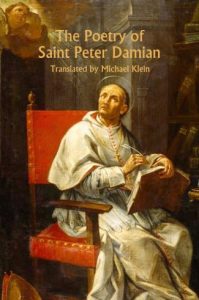
The Organization of the Poems – I decided not to use the traditional academic organization of the poems as this book is designed to reveal the many facets of Peter Damian through his poetry. I have organized the poems as follows.
These are beautiful poems where Peter Damian expresses his deepest religious feelings, often in words that might jar modern sensibilities.
Many, if not all of these, were for the use of the monks during their daily prayers. Many of the saints will not be recognizable to 21st-century churchgoers. They particularly address the early church martyrs.
Peter Damian was an early promoter of what has come to be called ‘the cult’ of Mary. One must wonder if it is at all related to his essentially motherless childhood.
Peter Damian was devoted to the Cross as a symbol of Christ’s suffering which he endured when he came to earth. The name of the monastery at Fonte Avellana and the monastic Order was, for many centuries, the Order of the Holy Cross. Peter Damian had a very close relationship with suffering as is shown in his use of flagellation and his near obsession with the details of the suffering of the martyrs.
These are just three poems written to celebrate a festival.
This is a selection of poems on many topics which reveal much about his personal and political activity.
This is a traditional classification of many verses ranging from one line to nearly thirty, some of these I have moved to the other categories. These are marked below with an asterisk *.